Excommunication – The Abuse of Biblical Doctrine

0e1bb7_a9458a1887a5433881d35e8e261ec66f~mv2

Today, I am writing with grief and hesitation in my heart, as I tell a story I never wanted to tell; however, I believe I must stand on the firm biblical ground to expose the problems we now see plainly. The problems that we have worked toward resolving, through conversation, leaving the church, writing blog posts, letter writing, and finally these series of articles. I am under no allusion that things will change, but it surely is my desire.

Therefore, having this ministry by the mercy of God, we do not lose heart. But we have renounced disgraceful, underhanded ways. We refuse to practice cunning or to tamper with God’s word, but by the open statement of the truth we would commend ourselves to everyone’s conscience in the sight of God. 2 Corinthians 4:1-2

Grace Fellowship Church (GFC) in Davenport, Iowa is, sadly, not all that unusual. There are many churches which have an outward appearance of fidelity to the Gospel, and which have orthodox statements of faith, but which utterly fail to “practice what they preach.” GFC often does not preach what its statements of faith proclaim. It is my hope that this series of (3) articles will put a spotlight on its heteropraxy, by which I mean how it leaves the boundaries of orthodox, biblical church practices and more readily resembles a cult.

While there are countless examples and descriptions I can write about, today I am choosing to focus on one issue, I will further address specifics, in an upcoming article, and then conclude in a third article with words from those that have left GFC, only to be disillusioned and most often confused with what church life should resemble. I have chosen this issue because this beautiful biblical doctrine, is being abused, misused, and misapplied for one reason, to control people. Control, and misapplication through excommunication are what most cults or cult-like churches do to wield control, and GFC has mastered these techniques.

Excommunication = Restorative 

In dealing with the topic of excommunication we have two primary passages of Scripture to be considered, but first it is important to understand excommunication is designed, by God, to be restorative, John MacArthur, in his commentary from Matthew 18, says:

The purpose of discipline is the spiritual restoration of fallen members and the consequent strengthening of the church and glorifying of the Lord. When a sinning brother is rebuked, and he turns from his sin and is forgiven, he is won back to fellowship with the Body and with its head, Jesus Christ.

Matthew 18:15-17 “If your brother sins against you, go and tell him his fault, between you and him alone. If he listens to you, you have gained your brother. But if he does not listen, take one or two others along with you, that every charge may be established by the evidence of two or three witnesses. If he refuses to listen to them, tell it to the church. And if he refuses to listen even to the church, let him be to you as a Gentile and a tax collector.

How we deal with sin in a local church body is explained in this passage. It is clear this is to follow a process, and the first step of that process is that a brother is in sin. 1 Corinthians 5 is the second passage that deals with the sinning church member. 

1 Corinthians 4:4-5 When you are assembled in the name of the Lord Jesus and my spirit is present, with the power of our Lord Jesus, you are to deliver this man to Satan for the destruction of the flesh, so that his spirit may be saved in the day of the Lord.

We can see the issue with blatant, in the open sexual immorality, and Paul tells the Corinthian church this man should be put out of the church. Paul’s desire for this man is salvation, and the purpose of putting him out of the church is the last resort to reconcile him back to a right relationship with the Lord and to restore fellowship in the church.


Excommunication NOT Retribution

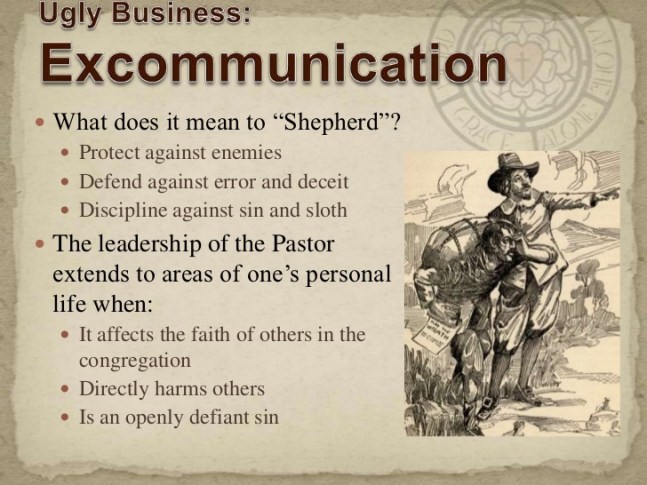
Excommunication is designed to be a tool, in proper biblical churches, to draw people back to fellowship, not to punish them for leaving the church, and that is the focus of this article. If a “church” consistently uses this tactic, to punish, and to alienate former members for leaving the church, is it a church, by biblical standards?

We were members of Grace Fellowship Church for nine years. In those nine years and the subsequent year and a half since our departure, and our excommunication, five more families, have been excommunicated.

Why you might ask? For leaving Grace Fellowship is the answer; all of these families are still serving the Lord; they still desire to be in a biblical fellowship and walk as Christians. According to GFC theology, it is a sin to leave a church.  According to Mike Reid (Pastor) there are only three or four ways in which you can legitimately leave a church, and if you did, he asks, “what scripture lead you to do that?”

Interestingly enough, what scripture lead him to determine those three or four ways of leaving are the only legitimate ways to leave and has anyone ever come to GFC that they have received into membership that left another local church, even against the counsel of that churches leadership? We know this to be hypocrisy because we know this to be true, and something I will address in the next article.

Last year Mike was invited to participate in a show, and his own words clearly illustrate his theology and ecclesiology. It will not take long to see you will not leave GFC very easily. This gives one illustration of a drift away from orthodox teaching, but there are many more. [This video was removed by Remnant Radio, why I do not know]

GFC is a church that falls into the category of biblicism. Biblicism (generally) is a doctrine that, at its essence, teaches that you must have a scripture verse to support anything and everything you do, ultimately, allowing the leaders to control the populace. If they do not have a verse to refer to, then it is not a biblical decision. The New Testament provides no clear definition of the decision to leave a church.

The New Testament does not give direct prohibitions, NEVER to leave, as well there are no commands that one must stay. There are legitimate reasons for wanting to leave that should not involve excommunication; however, at Grace Fellowship leaving, at the time of this writing, has ALWAYS resulted in excommunication for members, with perhaps the exception of one.

According to Bob Selph, teaching Pastoral Theology for the Reformed Baptist Seminary, there are times when it is necessary to leave.

There is a time to leave a church. When, because of faulty teaching or because of authoritarianism, which robs the child of God of his liberty in Christ, a person’s soul is under harm or that of his family, he must leave that situation in allegiance first of all to his King Jesus Christ.

He goes on to discuss the role of an elder not being too authoritative, or intruding into the lives of the congregation, furthermore, he says:

You or I may not particularly prefer or agree with our brother’s and sister’s personal choices, but rules that go beyond Holy Scripture are not to be forced upon the consciences of God’s free people. The church must not go beyond the clear teaching of Holy Scripture with regard to morally neutral activities and force a code of behavior upon God’s redeemed people. These areas are not under the province of the church unless they are done in direct violation of the law of God (10 Commandments) or done to such excess that the testimony of Christ and the church is obviously besmirched. See Confession’s chapter 21 on “Christian Liberty and Liberty of Conscience” to understand a person cannot give his conscience away to the lordship of a church or of anybody else.

Here is what lies at the bottom of Mike Reid and Grace Fellowship’s theology. The elders have extensive rule and authority over the church. When their authority is threatened or challenged, they will find a way to get back; ultimately, it is an impossible situation to leave. The truth is that the only way to leave GFC is either by death or excommunication, but never in ten plus years of the life of the church, has anyone left in a manner worthy of mutual agreement.

Working toward Agreement?

November 5th, 2018, I responded to a message that Mike Reid sent me, asking to get to together and seek our forgiveness. While on the surface this may seem like a commendable thing to do, and we wanted to be gracious in our response, I needed to discover if there was any sense of wrongdoing regarding our excommunication or willingness to overturn it. I responded with a lengthy letter explaining many issues we believe continue at the church and explaining them as some of the reasons for our departure.

Here is an excerpt from that letter:

Mike,

I received your message on October 24th (2018) and wanted to take this opportunity to respond, of which I’m grateful to do so, but I must first say, the message caught me off guard.  It has created some confusion in my mind as to the reason behind it, and while I don’t want to be ungracious in my response, it urges some questions to be asked.   I also must mention that if you believe you have witnessed the manifestations of my election through the years, you will deeply contemplate the things I present.

Our last communication was a letter in which we have been excommunicated from GFC, and all those in attendance were being instructed to interact with us in accordance to a couple of scriptural references.  I assume you would also fall under this instruction.

“The members of our local assembly will be instructed to interact with you in accordance with Romans 16:17 and 2 Thessalonians 3:13-15.”

We must deal first with these two passages.

Romans 16:17 I appeal to you, brothers, to watch out for those who cause divisions and create obstacles contrary to the doctrine that you have been taught; avoid them. 

Romans 16:18 For such persons do not serve our Lord Christ, but their own appetites, and by smooth talk and flattery they deceive the hearts of the naïve. 

This is clearly dealing with the unbelievers.  Verse 18 is the immediate context of the passage.  An attempt is being made by unbelievers to change and distort the gospel from what the apostles were teaching.  This is not what we were doing.  And in your message to me the other day you call me brother so, that is either untrue, or this is a misapplication of the verse.

2 Thessalonians 3:13-15 As for you, brothers, do not grow weary in doing good.  If anyone does not obey what we say in this letter, take note of that person, and have nothing to do with him, that he may be ashamed. Do not regard him as an enemy, but warn him as a brother.

The context of this passage is warning believer’s against idleness.  It’s distinctly clear from the preceding passages.  What troubles me is that you and (2) other elders at GFC approved this letter to justify what you didn’t like and put a blanket statement of “division” over our actions.  Individually the verses do not apply to us, nor do they have any relationship to one another.  Our shunning and excommunication were founded on the eisegesis of these texts by you, Tyler and Nick.

As I said earlier, I don’t want to be ungracious in whatever attempt this might be to reopen a line of communication, but it’s “out of the blue,” and for one, our excommunication needs to be dealt with first and foremost.  Where do the Jandt’s stand in relationship to you and GFC?  This can’t be swept under the rug. You have purposely distorted the truth, misguided the assembly, thus discrediting our family.   You further abused your role in the church, to do what seems clear you do not understand, by “excommunicating” us.  All an effort to control us and strike fear in the assembly.   We can’t simply dismiss what we believe to still be the problems that persist at Grace Fellowship. 


Serious Concerns

Are the elders ignorant of the doctrine of excommunication, or are they simply ignoring it to suit their desires? It is hard for me to imagine they are ignorant, as I have pointed this out to them in the letter, as others have pointed it out to them in the past.

Why would a legitimate man of God desire to distort the Bible’s teaching?
120302-church-discipline-and-excommunication-12-728

Additionally, the congregation plays a role in these decisions. Is the congregation also ignorant, or are they ignoring these truths or lack of truth in order to support their leaders?

I clearly understand the persuasive powers Mike Reid has and the leadership structure he has set up, and how he has convinced the flock that the elders have been ordained by God to speak for the church. Disobedience to them is tantamount to disobedience to God himself, and once again, these tactics are consistent with cultish churches.

Is Grace Fellowship Church a cult, or simply cultish? These are legitimate concerns for those that might attend there, but these believing members that are still in the congregation need to examine the Scriptures. Are the practices of GFC biblical? If not, the members have a responsibility to stand for truth or leave. They are culpable as well, should they continue to support their leaders.

“A single witness shall not suffice against a person for any crime or any wrong in connection with any offense that he has committed. Only on the evidence of two witnesses or of three witnesses shall a charge be established.” Deuteronomy 19:15

These are serious claims, and there is no shortage of witnesses to the evidence against GFC and leadership. After our departure in February of 2018, at last count, eight other families had left, some members, some non-members, and to my knowledge, all members received excommunication letters from GFC. Many of those were long-term members, one family had been there since the very beginning, just as we had, and they desired to leave well. Leaving well is not possible. Leaving is anarchy to leadership, and it must be dealt with in a heavy-handed manner, as a warning.

I wrote a blog series on Churches that Abuse and all of the tactics described in the book by Ronald M. Enroth. Grace Fellowship utilizes most of these tactics. These are not unique. The, at best, heterodox teaching of GFC is dangerous, and one member, well-known evangelist Tony Miano, before becoming a member had engaged in working through the notorious cult Church of Wells. Tony did a three-hour interview discussing the techniques and the issues, and firmly warned those that might be in a church like this, and now, ironically, is in a similar situation himself. This link is a valuable resource as to how these places operate, and yet Tony is now a member in a place that operates in like manner.

Fighting for the Gospel

I write this knowing full-well we were at this place for nine years, we participated in the same sort of actions, doing exactly the same thing; going along without question because of the teaching. However, God in His great mercy revealed these truths to us in His perfect timing. We had gone back to those excommunicated before us, sought their forgiveness and confessed our sin of participation before them, we sought reconciliation and have received nothing but mercy and grace.

Ultimately, I always come back to the decision that this is a gospel issue. GFC is devoid of true gospel freedom for its members and attenders. The heavy hand of authoritarianism and legalistic preaching and tendencies wreaks in the place. It is a burden for the children and for those that truly have a desire to serve the Lord, and leads them into great confusion as to the balance between the law and the gospel.

I do not want to belabor what others have already said, or tried to do, but to plead with current members to look at the Scriptures and closely examine the teaching and this article, speak with those you have been told not to speak to and seek counsel outside of the leadership. When you can stand back, clear your head, and hear from others, you find amazing clarity.

Always Hopeful

Lastly, I write this out of a heart to see change. Most likely, I will never have the opportunity to stand before the congregation and bring witnesses to rebuke a sinning elder or three sinning elders, and therefore, my only hope is that this can be exposed that nobody will ever be hurt again by this misuse of church power, and unqualified leadership.

Additionally, I have offered to pursue Chapter 26, paragraph 15 of the 1689 London Baptist Confession of Faith, to work through this with multiple churches and their representatives.  In an email I wrote to Mike Reid December 7th, 2018, I stated:

We desire peace, yet our peace must be in the Truth.  We can have a worldly peace between us, we can say “hi” at the grocery store, but true peace at its very core is a gospel issue.  And I believe this is where the problem lies between us.  As the 1689 provides a provision for others to provide counsel, I’m willing to seek that out.  See Chapter 26 paragraph 15.  But who could that possibly be?

I still stand prepared to go through with this process and offer that challenge today, yet this must be done with great care, with well-respected, confirmed, and legitimate ministries. After all that has transpired, after many written words, after all the hurt feelings that have come and gone, we are still hopeful for those that remain. We are hopeful they will eventually see through the control, see through the manipulation, and see through the misuse of the truth of the Scriptures. We continue to pray for them by name, and in earnest expectation of great things happening, we will not give up, because those that went before us, never gave up.

My family and the recent families that have left have found the Jesus they sought, to be far more gracious than they could have ever imagined. Man-made rules and regulations do not lead to higher holiness, only self-righteousness, and lack of joy. There is freedom in Christ on the other side, and that is my plea.

Beloved, do not believe every spirit, but test the spirits to see whether they are from God, for many false prophets have gone out into the world. – 1 John 4:1

May the Lord do as He sees right.

Kevin

Churches That Abuse – Final Thoughts

Jesus_Saves_Neon_Cross_Sign_Church_2011_Shankbone

In this post I’ll be wrapping up my review of Ronald M. Enroth’s book Churches that Abuse, I have some final thoughts, admonitions and hope for this series.  I hope that someone may recognize the characteristics of an abusive church and know how to stand against them.  It is also an admonition and warning those that continue in and support these churches to stop supporting them and work toward change or leave them.  Since the garden, Satan has been working to disrupt and distract from the simplicity of the gospel message.  Christ has established the church to bring glory and honor to Himself and the adversary is constantly working to distract us from the gospel message.  Let us not forget it is Christ’s church.

Pastoral abuse can be spotted quite easily, at least in its advanced stages.  Abusive religion substitutes human power for true freedom in Christ.  Unquestioning obedience and blind loyalty are its hallmarks.  Leaders who practice spiritual abuse exceed the bounds of legitimate authority and “lord it over the flock,” often intruding into the personal lives of members. God’s will is something that they determine for you rather than something you individually seek to know.  Abusive leaders are self-centered and adversarial rather than reconciling and restorative.[1]

God’s sheep can experience abuse, but they can also be complicit in the act of abuse; Paul warned Timothy these things would happen.  Paul’s warning against “easy believe-ism” in 2 Timothy 4:3-4 applies just as much to conservative churches.

For the time is coming when people will not endure sound teaching, but having itching ears they will accumulate for themselves teachers to suit their own passions, and will turn away from listening to the truth and wander off into myths.  2 Timothy 4:3-4

Notice, Paul writes about people having teachers “to suit their own passions…” Have you ever known a legalist?  They love legalism.

Have you ever wondered why it’s so difficult to leave an abusive relationship?

Abused individuals sometimes turn away from listening to the truth and they prefer myths. There becomes a level of comfort with the situation.  The Stockholm Syndrome can become a very real thing.  Abusive teachers stay in power because the people either tolerate them or even celebrate them.

What protects sheep from abuse?  Who monitors them?  Biblically, a plurality among leadership is helpful except when they all believe and support the same theories  or have one dominant personality or confrontation and disagreement is not allowed.

Confessions of faith are a safeguard, yet even confessional churches can fall into the trap of authoritarianism.  The 2nd London Baptist Confession of Faith of 1689 offers a remedy:

Chapter 26 – Paragraph 15. In cases of difficulties or differences, either in point of doctrine or administration, wherein either the churches in general are concerned, or any one church, in their peace, union, and edification; or any member or members of any church are injured, in or by any proceedings in censures not agreeable to truth and order: it is according to the mind of Christ, that many churches holding communion together, do, by their messengers, meet to consider, and give their advice in or about that matter in difference, to be reported to all the churches concerned;29 howbeit these messengers assembled, are not intrusted with any church-power properly so called; or with any jurisdiction over the churches themselves, to exercise any censures either over any churches or persons; or to impose their determination on the churches or officers.30
29 Acts 15:2,4,6,22,23,25
30 2 Cor. 1:24; 1 John 4:1[2]

It’s important for local churches to have other local churches that come together and solve problems that have moved beyond the singular local church.  But is it even possible for abusive churches or authoritarian leaders to seek and follow counsel from outside sources? Notice the purpose is not “to impose their determination on the churches or officers” but to counsel with them. Authoritarian, abusive leaders don’t take counsel from others.

Plans are established by counsel; by wise guidance wage war. – Proverbs 20:18

Most of the abusive churches I have studied are independent, autonomous groups.  They are not part of a denomination or network that could provide checks and balances or any kind of accountability.  As we have seen over and over again in these pages, their leaders are accountable to no one and resist any outside scrutiny.[3]

Author, blogger and open-air evangelist Peter Boland made the observation that, “Some of the issues are fairly widespread. It seems to have crept into the Reformed camp due to an overreaction regarding church membership. It’s an overreaction to ‘easy believe-ism’ and the ‘no commitment’ church attendance of the 20th century. So now there is this strong emphasis on the membership submitting to the authorities and powers that be, in order to prove, that we are somehow wiser and holier, and that we have more of a ‘healthy church,’ than those mainstream Evangelical churches of the 20th century.”

Abuse can happen on all levels but as people seek a deeper understanding of Christianity, they seek Bible teaching, they affirm and long for more than a surface level faith, and there can be an overreaction.  Sometimes young or growing Christians can swing the pendulum in the other direction.  The Marrow Controversy of the 18th Century exemplified some of the very same issues as Sinclair Ferguson has so eloquently written about in his book, The Whole Christ.

In the well-known sermon Ten Shekels and a Shirt, Paris Reidhead describes the prophet seeking a place to fit.  He was willing to settle for a paycheck and a garment of clothing.  He wasn’t terribly interested in pursuing the best interest of his congregants and ultimately the Lord.  While he may have thought he was, he had an ulterior motive.

Today’s abusive pastor has an ulterior motive.  His life doesn’t match his words.  As John MacArthur describes, “he’s a moral heretic.”  When power or position has been achieved, it’s difficult to let go.  It’s difficult for an authoritarian man to face the truth that his life doesn’t match his speech.  Is the expectation perfection?  Of course not! But these men are called to a high standard and blatant hypocrisy should never be accepted.

As long as Satan prowls around seeking whom he may devour, there will be abusive churches.

Therefore be alert, remembering that for three years I did not cease night or day to admonish every one with tears.  Acts 20:31

The antithesis of the misuse of power is gentleness, which is best seen and understood within the framework of strength.  Gentle leaders, pastors, or teachers do not force their insights and wisdom on the unlearned, nor flaunt their gifts before those in need.  They are patient.  They take time for those who are slow to understand.  They are compassionate with the weak, and they share with those in need.  Being a gentle pastor, shepherd, leader, or teacher is never a sign of being weak, but of possessing power clothed in compassion.[4]


This [gentleness] is in stark contrast to the style of abusive leaders, who, as we have seen, often lack compassion and a gentle spirit.  Power has a way of blinding the conscience so that those who spiritually and psychologically abuse others (like abusive parents) show little sign of remorse and repentance.  They deny any guilt for what they have done to people.  And they project their own weaknesses onto others.[5]

Be ever watchful dear friends, know the signs of an abusive church, know how they operate, and be aware.  The greatest defense against abuse is a knowledge of how abusive churches and leaders operate, and most importantly, having an intimate knowledge of the Scriptures.  May the Lord bless His sheep and keep them by His grace.


Kevin


[1] Churches That Abuse, 1992 by Ronald M. Enroth – page 217

[2]http://www.reformed.org/documents/index.html?mainframe=http://www.reformed.org/documents/baptist_1689.html

[3] Churches That Abuse, 1992 by Ronald M. Enroth – page 217

[4] Harrold Bussell, Unholy Devotion (Grand Rapids:  Zondervan, 1983), 70

[5] Churches That Abuse, 1992 by Ronald M. Enroth – page 219

Churches That Abuse – Part 4

freed-prisoner

About midnight Paul and Silas were praying and singing hymns to God, and the prisoners were listening to them, and suddenly there was a great earthquake, so that the foundations of the prison were shaken.  And immediately all the doors were opened, and everyone’s bonds were unfastened.  – Acts 16:25-26

God loosens the bonds of slavery and sets prisoners free.  Freedom gained through salvation and the merciful kindness of God gives an unlimited access to Him through the cross of Christ.  In abusive churches these lines are often blurred, or hard to see.  If eyes are opened, the most difficult step begins because to leave an abusive church is a painful process.

Continuing the series on the book Churches That Abuse by Ronald M. Enroth, I will examine two remaining topics.  The focus of this article is the painful exit process.  “To break away from the group required more effort than to join” and family members are pitted one against another to keep them and often citing passages like Matthew 10:34-39 as the justification for splitting families apart.

Ex-members were called quitters, turncoats, and traitors.  At first they simply lost their place in the Lord’s roll call, but gradually the act of leaving became an act of disloyalty.  Ex-members were not to be spoke to or about.  Georgia Sheller was told to have no fellowship with her parents who had left angrily and bitterly.[1]

To maintain control, the control-oriented leader must keep the sheep in the fold at all costs.  Enroth gives examples of two men, Don Barnett and Phil Aguilar, who used similar tactics, not uncommon for this type of a leader.

“God has called you to this assembly to furnish you with that which you need.  Do you have His permission to leave this assembly?” – Don Barnett[2]

“You need to trust God through me; I know what’s best for you.”  “I have the responsibility and the accountability according to God’s Word for each and every one of you.” – Phil Aguilar[3]

By comparison, the New Testament gives little indication about leaving a local church. While there are important principles that apply, specific instructions about moving one’s membership from one local assembly to another are not provided.  One need express caution when applying God’s word to descriptive but not prescriptive texts of the Bible.  Yes, every Christian should be committed and submitted to a local church, to live at peace, as much as depends on you (Romans 12:18)—it’s biblical. However, when leaders are over-bearing and controlling, leaving is the right thing to do.  When leaders lead a church unbiblically and when members put up with an environment “where there are no gray, only blacks and whites,”[4] the church ceases to be a biblical church and Christians not only have a right, but an obligation to leave.

In writing about Great Commission International (GCI), an organization founded in 1970 by “apostle” Jim McCotter, former member Jerry MacDonald notes that the group compares its leadership structure with a marriage.  “GCI elders frequently refer to ones that have left the church as divorcing themselves from their family.  They twist Scripture on God’s hatred of divorce and use it as a coercive technique to keep people from leaving their churches.  Thus, ones who leave are taught that they have actually left God and sinned.  What it really means is that the elders have usurped the loyalty and the devotion that is due Christ alone and refocused it on themselves.”[5]


MacDonald points out that the proof-text for the idea of “marriage” in relation to elders and leaders in GCI is found in Ephesians 5:22-6:9. The group cites 5:22 (“Wives, submit to your husbands as to the Lord”) as the key to their hierarchical system of authority.  “Just as wives are to be in subjection to their husbands, so the church is to be in subjection to the elders.  It seems that the elders are the physical manifestation of the authority of Christ.  Just as a family mirrors the church’s relationship to the elders, so a wife and husband in the bond of marriage reflect the subjection the congregation should have to the elders.”[6]


In the Great Commission International, much emphasis is placed on “trusting God’s leading through others” –the “others” being those in leadership.  In reality, this means surrendering one’s independence, obeying in all things, and submitting to the leaders.  As numerous ex-members of GCI have told me, it amounts to subjugation of members to the leadership.  Failure to comply with the authoritarian dictates of the group can result in ex-communication, a common practice in GCI and other abusive-church groups.[7]


If you do not give up your independence and follow in harmony, you will be reproved for “sowing discord in the body,” and if you still do not “harmonize,” you will be excommunicated for faction—since, according to GCI, there is no difference between trusting God and trusting a GCI leader.[8]

There are always certain “buzz-words” that carry weight in these assemblies and are commonly used by the leadership; words like authority, submission, love for the body. There are subtle, but well-known, unwritten rules.  There are even times when it may take “reproof” to bring members in line—those “wise in their own eyes” are dealt with quickly.  It is the unwritten code that is most powerful.  It is a life in a fishbowl, where every move is observed.

Enroth notes “excommunication is almost always accompanied by shunning behavior instituted by the leadership…One need not have psychological training to understand that such a procedure also operates as an effective control mechanism within a church.  Those who are the ‘boat-rockers,’ those who raise uncomfortable questions and who challenge the leadership in any way, are prevented from sharing their legitimate concerns and criticism with other members.  Dissent is muffled, and disinformation can ‘spiritualized’ or manipulated by the leadership.”[9]

Submission is biblical, but unmitigated submission without a clearly defined standard as outlined in Scripture is not.  When submission is stressed be on guard.  When mishandled, submission can undermine the whole teaching on the individual priesthood of believers (1 Peter 2:9).  We are called out individually and collectively to be in local church bodies for mutual edification, but not to have a heavy-handed form of church government upon you.

Leaving will be difficult, relationships that were once cherished will be lost, but to seek and find normalcy is well worth the effort to break free.  Good churches are hard, but not impossible, to find.  Pastors that preach the Word and allow the Holy Spirit to do His work are a treasure.

If you see any similarities in these words, seek the counsel of someone that has been in an abusive church before or has helped others escape, and read Enroth’s book.  It promises a bright hope through the One who never enslaves His sheep.


Kevin


[1] Churches That Abuse, 1992 by Ronald M. Enroth – Page 65

[2] Ibid – page 80

[3] Ibid – page 81

[4] Ibid – page 175

[5] Jerry P. MacDonald, “Manipulation of the Scriptures Within Great Commission International,” unpublished paper (1985), 186.

[6] Ibid

[7] Ibid

[8] Churches That Abuse, 1992 by Ronald M. Enroth – Page 182-183

[9] Ibid – page 183

Churches That Abuse – Part 3

sheep-surprised

Pay careful attention to yourselves and to all the flock, in which the Holy Spirit has made you overseers, to care for the church of God, which he obtained with his own blood. – Acts 20:28

Continuing the series on the book Churches That Abuse by Ronald M. Enroth, the focus for this post will build off the previous topic of control-oriented leaders and spiritual elitism.  For leaders to control and foster elitism there must be mechanisms in place by which control can be maintained.  We will consider aggressive shepherding, having a reporting system in place, and rigidity of lifestyle.

In Part 2, I included links for a movement in the 1970’s called the Shepherding Movement. Shepherding is a biblical concept, but over-shepherding is not.  Peter called it “lording over” or domineering.  Ezekiel describes it as harshness and using force:

The weak you have not strengthened, the sick you have not healed, the injured you have not bound up, the strayed you have not brought back, the lost you have not sought, and with force and harshness you have ruled them. – Ezekiel 34:4

Luke writes that men will arise from within the ranks and they will use subtle means to draw people away from the truth (Acts 20:31).

Enroth explains elements often employed by authoritarian leaders to gain control over a group of people:

Spiritually abusive groups routinely use guilt, fear, and intimidation as effective means for controlling their members.  In my opinion, the leaders consciously foster an unhealthy form of dependency, spiritually and interpersonally, by focusing on themes of submission, loyalty, and obedience to those in authority.[1]


According to a former member of the shepherding movement, so-called because its members had “shepherds” who require full submission and taught the need for “spiritual authority,” these “leaders” had the true story of what was going on.  Pastors exercised control and manipulation through their sermons.  Certain themes came through regularly: covenant, authority, obedience, submission, serving, honoring… [2]

Systematically arranging the sheep takes time to implement, but through consistent shepherding, sermons, and studies the calculating leader can accomplish his goals given enough time and buy-in from the people.  Scripture will certainly accompany his methods, but it is often twisted and utilized with a desire to accomplish the objective.

It is a difficult job for one or two shepherds to keep the sheep in line, so one of the strategies often implemented is a monitoring system.  Who better to monitor the sheep than the other sheep, or to have the sheep “self-report” through their own public confessions?  To promote holy living and growth, the sheep interact with each other more often than the shepherd does, so reporting on one another is very effective at creating an atmosphere for abuse.  Once again, mutual accountability is a biblical principle, but is a principle that can run amuck in the wrong hands.

Public times of confrontation, confession, and repentance were common, lasting anywhere from four to twenty hours…  The airing of the most intimate details of one’s life was seen as opening the way for God to take one deeper into the spiritual life.[3]


The leaders encouraged people, even children, to reveal each other’s faults.  In a world with few material possessions, the most minor flaws became the source of guilt and self-loathing…  It became a community obsession to root out the most minute bit of evil in their lives with a ruthlessness usually reserved for members of restrictive monastic orders.  “It mattered how you acted, how you talked, even how you thought and looked.”[4]

With this type of living and monitoring, one cannot help but be forced into a rigid lifestyle; it’s a very natural outflow.  Everything matters when supposedly striving for holiness and purity of life.  With aggressive shepherding through control-oriented leaders, a spirit of spiritual elitism, and sheep monitoring other sheep, there is no other option but rigidity.  The table is set for the leaders to abuse the sheep and the sheep are not even aware they have been taken in and deceived.  It is no different than boiling a frog.  The heat is gradually turned up, the monitoring system is fully in place, and the shepherd knows the condition of his flocks.

Is this what the Christian life is all about?

These people may feel as though they are free yet are in bondage to a system of legalistic expectations set up and enforced by their leaders and by themselves.  As The Eagles sang, “So often times it happens that we live our lives in chains, and we never even know we have the key.”

Now the Lord is the Spirit, and where the Spirit of the Lord is, there is freedom. – 2 Corinthians 3:17

Consistent with a number of similar groups, Pam and Tom’s fellowship attempted to live according to “first-century-church” standards.[5]


“We became victims of zealousness without knowledge.”[6]


As Pam looks back on the experience, she finds it hard to believe that when people called her brainwashed, she took it as a compliment.  “We were blessed to have a clean mind.  But it did reach a point where I didn’t decide things on my own.  Even vacations had to be cleared with leadership.”[7]

Pam and Tom’s experiences became increasingly more bizarre as leaders enforced a more rigid lifestyle the longer things continued.  “There wasn’t one area in our lives where we weren’t legalistic about something.”

Tom reflects, “It seems strange that during our time in the fellowship, you would think that the overwhelming evidence in the New Testament concerning grace would have had some effect upon our minds concerning these rigidities.”[8]


In addition, Pam notes, “I lived in fear of correction, while Scripture tells us to embrace and love it.”  Also, many of the rules and regulations were never actually spoken or articulated as a command.  One simply knew from experience that something was a rule, and, if not adhered to, discipline resulted.[9]

When rigid lifestyles and interactions are demanded, any kind of disagreement is suppressed.  It won’t be tolerated, it creates “division” within the ranks, uprisings are quickly dispatched.  “Conscience became externalized” and members are taught to not “trust their feelings, intuition, and emotions.”

“We stifled the voice of God within, mistaking common-sense reactions for the ‘rising up of the flesh.’”[10]


Pam knew that even when she desired to stand and say, “This is crazy!” or, “I don’t agree!” she would have been disciplined for disrupting and coming against authority.[11]

Tom Murray gives a final warning: “It is foolish to think that you can remain objective in an abusive-church situation for any length of time without being subtly influenced.  No one can consider themselves above the possibility of deception.”

The only way to avoid this deception and spiritual abuse is through the Word of God and by the Spirit of God.  If you find yourself in an abusive church, you must leave, but it’s never easy, and as I will write about next time, abusive churches are difficult to escape.


Kevin


[1] Churches That Abuse, 1992 by Ronald M. Enroth – Page 103

[2] Ibid, – Page 107

[3] Ibid – Page 86

[4] Ibid – Page 60

[5] Ibid – Page 128

[6] Ibid – Page 129

[7] Ibid – Page 129

[8] Ibid – Page 130

[9] Ibid – Page 130

[10] Ibid – Page 131

[11] Ibid – Page 131

Churches That Abuse – Part 2

29694550_1993639500886568_6998974256251928576_n

Today I will continue a blog series on the book Churches That Abuse by Ronald M. Enroth with a focus on control-oriented leadership and spiritual elitism–two hallmarks of abusive churches.

What is it that makes a church a “special” place for its members?  Charismatic leaders have an influence on people, sometimes for good, but in the case of an abusive church, disastrous.  These leaders control the vision for the church through persuasive speech and bold proclamations.  This is how Pastor Barnett built his church.

If there is just one word to describe Don Barnett and his church, it would be “control” –autocratic control over the lives of the individual members.  Barnett’s pastoral “concerns” went so far as to dictate how close together people should sit in the pews of his church…[1]


Most members experienced a totalitarian system of control in which all free time, outside of employment, was given to the “assembly,” or church….   It was not unusual to spend five or six nights a week in church.  When asked what members did for fun, Robin responded, “That is what we did for fun, we went to church.”  [2]

As we’ve seen above Pastor Barnett had total control.  Often, new believers are easy targets, and while they may be familiar with the bible they don’t always have a good command of the bible.  They can be swayed by the truth with a slight degree of error.  Truth mixed with error is error and the subtle errors are the most difficult to detect.

The tragedy of Community Chapel goes back to a misplaced loyalty.  People, thinking that they were placing their allegiance in the Word of God, were actually placing their allegiance in a man and his interpretation of the Word of God.  That is crucial to understanding why people were so easily deceived.  They thought that they were really obeying the Word of God.


The comments of a former elder who was associated with the church for eighteen years before resigning are insightful: “As I look back on it now, it is clear that, subtly at first, there began to be a feeling of superiority and exclusiveness among the people.  This was more evident in some than in others, but I think we all were affected by it.  There began to be a feeling that this church was unique, and that while we loved other brothers in Christ, to leave Community Chapel would always be a step down spiritually.


The pastor rarely had other preachers in to minister to us, feeling that they really couldn’t add anything to us, and might only foster divisions and problems.  I feel that this is one of the critical factors in the sad things that happened later: no checks and balances with the rest of God’s people, and no accountability to other men of God outside our own little circle.[3]

Controlling leaders able to articulate the “specialness” of the church, create a buy-in process for the membership and future members.  “We’re unique! There’s no one else like us! We’re faithful!”

You will hear things like “Other people really wish they had a church like this…”

“I just don’t hear about the type of love we show one another…”

“Some may think this is legalism, but it’s really a desire to pursue a higher level of holiness…”

Spiritual elitism can be fostered through daily life and it is often controlled through a systematic message, consistently fostered through the leadership.  We are the “Special Forces” of the church world.  We take it to a whole new level, exemplifying the Christian pursuit of Christ’s calling.

As one ex-member put it, “We believed we were on the cutting edge of what God was doing in the world.  I looked down on people who left our movement; they didn’t have what it took.  They were not faithful to their commitment.  When everyone else got with God’s program, they would be involved in shepherding just like we were.”


Community Chapel’s Pastor Barnett regularly reminded his followers that their church was special.  “We’ve got to go on into a new thing that God promised in his Word that no church has ever come into yet…. Do you know of any other church in which people are loving each other with that same kind of unconditional love?  I don’t.”  [4] 

Spiritual elitism convinces members that their families need special attention.  They have not heard, nor have been under, the teaching of these leaders, they are certainly a lesser Christian if even a Christian at all. Barbara explains her experience:

Because she came to believe that her whole family would be lost if she didn’t try to convert them (the Boston churches constituted the only “true Church”), Barbara was constantly speaking to them about their salvation.  Her family grew tired of the spiritual barrage, as did her old friends, so Barbara ended up moving into an apartment with four other women from the Phoenix Valley Church of Christ.[5]

There is an intense pressure to save those we love and, as Barbara stated, “She constantly felt guilty.”  Christians don’t desire to see their loved ones suffer in Hell; and their salvation can only come by a prescribed manner consistent with the abusive church.

The Spiritual Elite Churches place a high emphasis on evangelism and efforts are commended where many are reached for the lost through passing of pamphlets and tallies of the amounts that went out.  The modern church is an easy target to setup the elitism because there is a seeming lack of passion for the lost. In elitist churches, unhealthy expectations and feelings of guilt are entrenched if members are not working for God to bring the lost to Christ in the way they’ve been instructed to do so. After all, they wouldn’t want to be like all the other so-called Christian compromisers out there.

Spiritual elitism, fostered by control-oriented leaders, leads to churches that abuse because at the root of the problem is spiritual pride.

One’s pride will bring him low, but he who is lowly in spirit will obtain honor (Proverbs 29:23).

Next time, we will discover that maintaining control requires a system of reporting and monitoring of the sheep through what’s called “the shepherding movement” and Here.


Kevin

[1] Churches That Abuse, 1992 by Ronald M. Enroth – Page 37

[2] Ibid – Page 38

[3] Ibid – Page 48

[4] Ibid – Page 118

[5] Ibid – Page 112